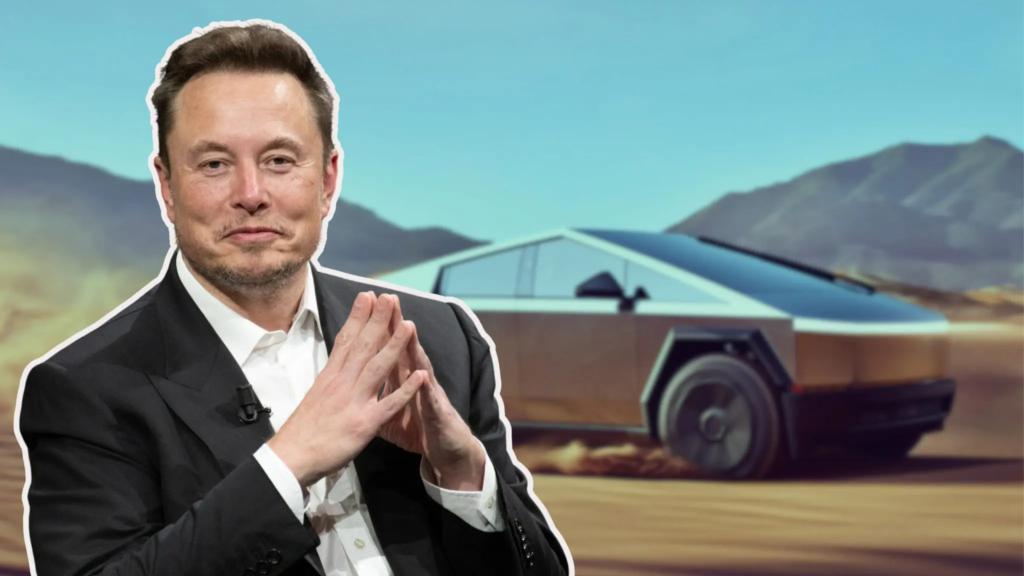
Someone once pointed out that whenever you see someone getting out of a Cybertruck, it’s usually a very normal suburban dad type.
The observation was that it would make more sense if the driver stepped out wearing a futuristic outfit or space suit.
I actually agree with that.
It would be more coherent.
Because the Cybertruck mostly belongs nowhere.
And when people call it ugly, I don’t think that’s the real issue. “Ugly” is just the label people reach for when something feels wrong but they can’t quite explain why.
The deeper issue is environmental coherence.
The Cybertruck functions like a normal car. It drives on the same roads, parks in the same parking lots, sits in the same suburban driveways as everything else.
But visually it looks like it arrived from a completely different environment.
You see one in a grocery store parking lot and it looks off.
You see one in a suburban neighborhood and it looks off.
Can you imagine one parked next to a farmhouse or in a rural town? No, it still looks off.
It has that same quality I’ve talked about with clothing: technically correct, but slightly assembled.
We recognize what it is, but it still feels staged.
It almost feels like it belongs somewhere else entirely. A Mars colony, maybe.
And when something looks that disconnected from its surroundings, it quietly destabilizes the environment around it.
Not dramatically.
Just enough to make things feel slightly less settled.
A quick clarification
When I talk about environmental coherence here, I’m not talking about environmental impact in the climate sense, although that’s obviously an important conversation.
I’m talking about how objects visually and physically relate to the environments they inhabit.
How they sit within streets, neighborhoods, landscapes, and daily routines.
The pickup truck problem
I notice something similar with extremely large pickup trucks.
I live in a state where they’re popular, and they seem to get bigger every year.
To be clear, pickup trucks have real uses. Construction, hauling equipment, commercial work.
I remember in the 90s one of my childhood friend’s older brother had a truck. He would pile all the neighborhood kids in the back to take us to the park.
My late grandfather had one too. He’d drive us around his farm and we’d hop out of the back to pick blackberries.
I have good memories with pickup trucks.
But those trucks belonged to those environments.
Many of the trucks on the road now are so large they become environmentally incoherent in everyday situations.
They’re enormous relative to the scale of parking lots, suburban streets, and office complexes.
I remember once taking a quick nap in my car during lunch when a massive truck tried to back into the space next to me.
The space was clearly too small. But the driver was determined to make it work.
Eventually he backed into a concrete pillar and crushed his tail light.
I remember thinking: you work in the same cubicle farm I do.
What exactly are you hauling?
When cars became semiotic
Part of the issue is how cars eventually got marketed to us.
There’s a whole complicated history behind this, but over time cars became less about transportation and more about identity.
What does your car say about you?
Your car should reflect your personality.
Your car should send a message.
This should sound familiar to you.
It’s the same logic that shows up in style culture.
I fell for it too
I had my last car for ten years and never planned to replace it.
Then someone rear-ended me and totaled it.
Suddenly I was in the market for a car, and I was surprised by how quickly the symbolic thinking kicked in.
I started wondering things like:
What vibe should I go for?
Does this fit my personality?
Maybe I should upgrade now that I’m older.
Maybe I should “live a little.”
Meanwhile the actual conditions of my life were extremely simple.
I mostly work remotely. I leave the house occasionally. I drive to the grocery store.
After test driving several options, I ended up buying a newer version of the exact same car I had before.Which in hindsight makes perfect sense
Sometimes the most coherent solution is the simplest one: just buy the car that fits your life. Not the one that’s trying to say something about it.
Older cars often felt more normal
Interestingly, a lot of older cars seem more coherent in this sense.
Partly because their designs were simpler. Partly because there were fewer variations. And partly because they were built around more modest conditions.
They blend into their environments more easily.
They don’t feel like they’re trying to represent an identity.
They just look like vehicles cruising through a landscape.
The pattern again
Which brings me back to a pattern I keep noticing.
When objects are designed primarily to signal something or “stand out”, they often become slightly detached from the environments they’re supposed to live in.
The surrounding environment starts to feel a little uneasy and frankly looks a little less beautiful.
Maybe that’s why the Cybertruck feels so strange in everyday life.
It isn’t responding to the environments we actually live in.
It’s responding to an imagined one.