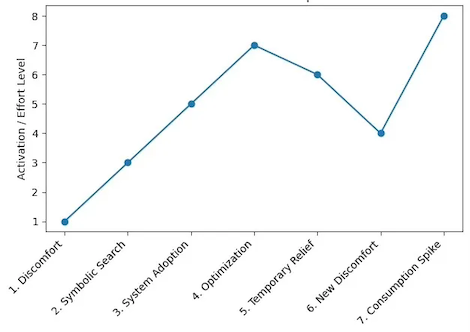
I think most people think their entry point into style is: “I want to look better.” or it might be context driven “I should get something nice for this work event.”
But the real starting point is usually: “Something feels off.” Not emotionally, but physically. So the aesthetics search does not usually start with insecurity. It starts with body discomfort.
Stage 1: Subtle Discomfort
You might feel:
- slightly exposed
- slightly unfinished
- slightly “on” in your body
- clothes feel noticeable
You’re not sure why. So your brain looks for an explanation.
Stage 2: Symbolic Search
Now you enter the semiotic layer.
You ask:
- What aesthetic am I?
- What’s my body type?
- What’s my color season?
- What vibe am I?
- What message do I want to send?
You do this because most style culture only offers identity or symbolic language, not sensory language.
Stage 3: System Adoption
You find a system that explains the discomfort:
- Kibbe
- Color analysis
- Essence systems
- Parisian chic
- Workwear
- Quiet luxury
- Ivy style
- Preppy
- Normcore
- City Boy
This is a never-ending list and it doesn’t matter which one you choose. Relief will appear briefly because you found a system. It’s the structure of the system, not the clothes, that makes you feel stabilized.
Stage 4: Optimization Phase
Now the system becomes a fun refinement game.
You start:
- tweaking silhouettes
- swapping fabrics
- buying “better versions”
- tailoring
- editing your closet
Your belief becomes: “I am close. I just need the right version.”
Tension increases here even if it you think you are being productive.
Stage 5: Temporary Relief
Finally you hit a moment where:
- an outfit works
- you look good
- you maybe get compliments
You think: “I figured it out.”
But the relief is temporary .
Stage 6: New Discomfort Appears
Soon:
- a garment feels off
- a color feels wrong
- a new context arises
- a new aesthethic crops up
- you feel “off” again
This happens because the system never addressed the sensory layer. So your body speaks again.
So your style brain says: “I must refine more.”
Stage 7: Consumption Spike
You buy again.
And again.
But now purchases are driven by:
- the hope of completion
- chasing “the final version”
- correcting micro-imperfections
This is where decluttering and overconsumption happens. Your style brain justifies it by saying: “ I just have good taste” or “fashion is my hobby.”
Why It Never Ends:
Because the problem was never about finding your vibe.
It was:
- surface density
- weight
- drape
- proportion
- movement
- sensory load
But the solution offered was always, more meaning and more expression. So the search continues.