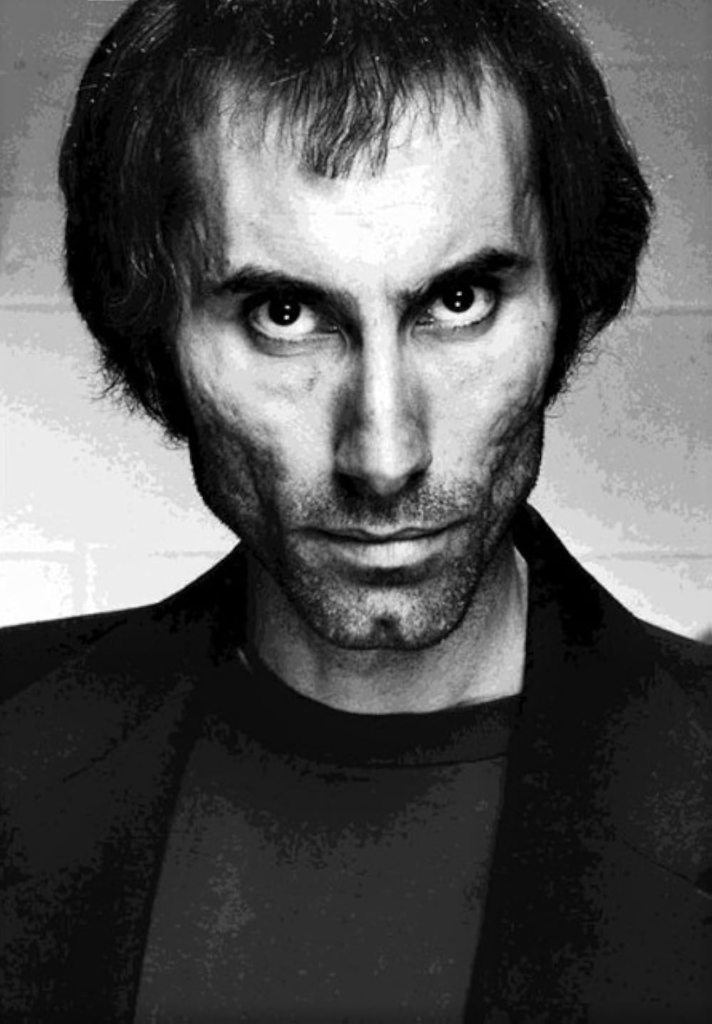
I have some more thoughts about the gap between appearance and identity.
I was reading Anthony James’s memoir Acting My Face. He spent much of his career being typecast as villains, criminals and creepy characters. His headshot was even referred to as the “basic killer” shot.
As a teenager heading to Hollywood, he wanted to showcase range. He quickly realized that wasn’t going to happen.
At one point he wrote:
“They only wanted my face.”
Not him.
Just what people thought his face meant.
That projection followed him off screen too.
He described being on a date where a woman told him she was attracted to “gangster types.” She fixated on his roles. On what she thought he represented.
At one point, she asked him to act like one of his characters.
He told her:
“I’m nothing like the parts I play. That’s why it’s called acting.”
She immediately lost interest.
He wasn’t the character.
He could just perform it.
Where Style Advice Steps In
Style advice does something similar.
“Dress for your face” is common advice. There are entire systems built around it. Dressing Your Truth. Essence systems. Face typing.
Sometimes it’s expanded into hair, voice, body and movement.
Your features fall on a spectrum. Curved or Angular. Youthful or Dramatic. Feminine or Masculine.
And your clothing is supposed to mirror your face.
If you get it right, you will dress better and people will understand you.
But the cost is now you’re managing a symbolic identity.
Where It Starts to Break Down
Obvious point : No one fits cleanly. There is always overlap or some contradiction.
The systems will admit this too.
It’s presented as flexibility or nuance within the framework: “You can be a blend of two or more categories”. As if that acknowledgment makes the system more accurate.
But you are still being asked to fit into a structure.
So you start managing it.
Leaning into certain traits and downplaying others. Trying to harmonize everything.
It starts to feel a bit reductive.
As if everything about you has to be explained through your face.
A Real Life Baby Face Problem
I once knew someone who hated having a baby face.
He tried to look older by growing facial hair.
This helped a little, but not really.
I don’t think the issue was he didn’t lean into his baby face enough and wear youthful clothes.
The issue was he was responding to how other people saw him.
He was trying to correct a projection.
And that’s what made it look a little off.
And slightly constructed.
Projections aren’t stable
Another obvious point: people don’t all see the same thing. The same face can be read very differently depending on who is looking at it.
I first saw Anthony James in an episode of Columbo.
He played a troubled kid falsely confessing to murder, but that’s not what stood out to me.
I was more focused on other things. His age. He looked too old to play this character. And his skin tone. Did he have a tan or was it the lighting?
One of my observations was confirmed in his memoir.
He mentioned adjusting his appearance depending on the role. Sometimes he applied darker makeup or eyeliner to increase the characters intensity.
The Unfortunate Reality
Sadly, your face will become a shortcut for many people.
People will project and assign you roles you never asked for.
But that doesn’t mean it’s accurate and it doesn’t mean you need to manage it either.
You do not need to organize yourself around your face.
A cleaner place to start is somewhere else entirely.
Not your face or people’s interpretation of it.
But your actual environment.